Forex for beginners, a step-by-step start from market basics to a first trade
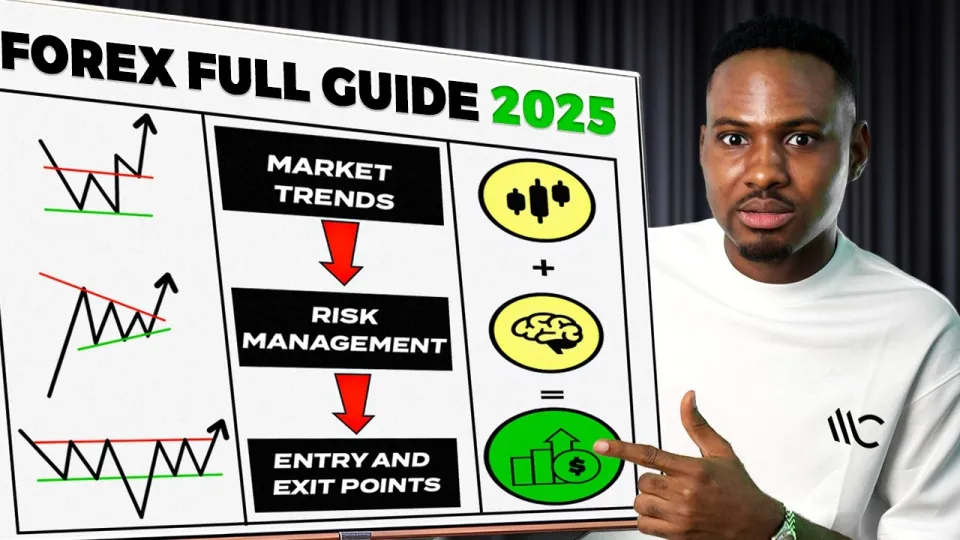
Video: How To Start Forex Trading For Beginners’ 2025 (Full Course)
Want articles like this for your own video to promote it on YouTube and Google? Order them through the Telegram bot @sat_sit_bot. It writes articles around your video, embeds the video and publishes them on popular niche websites (no ads). Your first 50 articles are free.
· based on the channel Jeffrey Benson Forex
Key takeaways
- Forex is an over-the-counter market where currencies are quoted in pairs; the first currency is the base, the second is the quote.
- Trading runs 24 hours a day, five days a week, across four sessions: Sydney, Tokyo, London and New York.
- A standard lot is 100,000 units of the base currency; one pip on EUR/USD equals about $10 per standard lot.
- Leverage multiplies both profit and loss, so position size and stop-loss placement decide survival more than entry accuracy.
- A beginner's path: demo account, one strategy, a trading journal, then a small live account — in that order.
Forex for beginners is the process of learning how currency pairs are quoted and traded, opening a demo account with a regulated broker, building one simple strategy with fixed risk per trade, and only then funding a small live account. The full beginner course from Jeffrey Benson Forex walks through exactly that sequence — market structure first, tools second, trades last — and the paid student track behind it is available at Fire Pips FX plans.
What forex trading actually is
Forex is the global market where one currency is exchanged for another, and every price you see is a ratio between two currencies. A quote such as EUR/USD = 1.0850 means one euro costs 1.0850 US dollars; the euro is the base currency, the dollar is the quote currency. There is no central exchange — trading happens over the counter through a network of banks, brokers and liquidity providers, which is why prices differ slightly between brokers and why you trade against your broker's feed rather than a single order book.
Four ideas cover most of the vocabulary a beginner meets in the first hour:
- Pairs and majors. EUR/USD, GBP/USD, USD/JPY and USD/CHF are the most liquid pairs, with the tightest spreads and the most predictable behaviour around news.
- Pips. A pip is the fourth decimal place on most pairs (the second on JPY pairs). On a standard lot of 100,000 units, one pip on EUR/USD is worth roughly $10.
- Lots. Position size is expressed in lots: standard (100,000), mini (10,000), micro (1,000). Most beginners should start at micro.
- Spread and swap. The spread is the difference between bid and ask and is your immediate cost; swap is the overnight financing charge for holding a position past the daily rollover.
How the forex market works during the day
The forex market is open 24 hours a day from Sunday evening to Friday evening (UTC), and its character changes with each of the four sessions. Sydney opens the week, Tokyo follows, then London, then New York; the London–New York overlap is where most of the daily range and liquidity appear, and it is where beginners usually find the cleanest setups.
Direction comes from interest rates, inflation data, central-bank decisions and risk sentiment. A scheduled release such as US non-farm payrolls or a Federal Reserve statement can move a major pair 50–100 pips within minutes, and spreads widen sharply in the seconds around it. That is not a reason to avoid the market — it is a reason to know the economic calendar before you place an order and to avoid holding tight stops through a release you did not plan for.
Tools and broker setup every beginner needs
A working forex setup is small: a regulated broker account, a trading platform, a charting routine and a journal. MetaTrader 4 or 5 covers charting, order types and one-click execution, and most brokers supply it free; TradingView is a common alternative for cleaner chart analysis. The broker matters more than the platform — check regulation, client-fund segregation, typical spreads on EUR/USD, minimum deposit and whether micro lots are allowed.
The course recommends Assex Markets as the broker to use, with registration at https://my.assexmarkets.com/auth/register?partner_code=1699134, and links a separate walkthrough for connecting the account to MT5. Treat any broker recommendation, including this one, as a starting point for your own due diligence rather than a guarantee.
A practical setup order looks like this:
- Register and complete identity verification before depositing anything.
- Install MT5, log in to the demo account, and add EUR/USD, GBP/USD and USD/JPY to the watchlist.
- Set the chart to a higher timeframe (4-hour or daily) for direction and a lower one (15-minute or 1-hour) for entries.
- Create a demo account with the same balance you intend to fund live — a $10,000 demo teaches different habits than a $200 one.
- Log every trade: pair, direction, entry, stop, target, reason, outcome.
Building a basic strategy foundation
A beginner strategy needs three answers before any entry: which direction, where the stop goes, and where the trade is finished. A workable starting framework is trend-following on a higher timeframe with a pullback entry — for example, price above a rising 50-period moving average on the 4-hour chart, a pullback to a recent support zone, and a bullish confirmation candle on the lower timeframe. The stop sits beyond the zone that invalidates the idea; the target is at least twice the stop distance.
Risk management is the part that decides whether a beginner survives long enough to learn. A common rule is 1% of account equity risked per trade: on a $1,000 account that is $10, which at a 20-pip stop means roughly 0.05 lots on EUR/USD. Two or three consecutive losses at that size cost 2–3% of the account, not 30%. Leverage of 1:100 or 1:500 does not change that math — it only changes how large a position the broker will let you open, and using all of it is the single fastest way to lose an account.
Placing a first trade without guessing
A first trade should be a planned execution of a written setup, not a reaction to a candle. On the platform, that means choosing market or pending order, setting the stop-loss and take-profit in the same ticket, and sizing the lot so the stop equals your fixed risk. If the platform does not allow the lot size you calculated, the account is too small for that stop distance — widen nothing, reduce size or skip the trade.
Before going live, run the setup at least 20–30 times on demo and record the results. If the journal shows no edge after that sample, the strategy needs adjustment, not more capital. When the numbers hold, fund an amount you can lose without changing your life, keep the same position sizing, and expect the first live month to feel different from demo purely because the money is real.
Common beginner mistakes and the questions they raise
Most beginner losses trace back to a short list of repeatable errors rather than bad luck. Watching tutorials without writing anything down is one: viewers of this course repeatedly note that taking notes during the session is what makes the four market sessions and the risk rules stick. Others are over-leveraging on a small account, moving a stop-loss to avoid taking a loss, trading every session instead of the two that suit your schedule, and switching strategies after two losing trades.
A second cluster of doubts is about pace. Beginners ask how long before trading becomes profitable, whether a small account can grow, and whether signals can replace learning. The honest answers: expect months of demo and journaling before consistency, judge a small account by percentage return rather than dollar profit, and treat copy-trading or signal channels — including the free daily signal at https://t.me/firepipsignals and the premium group at https://t.me/jeffreybenzhelpbot — as a supplement to your own process, never a substitute for understanding the trade you are in.
Useful links
- Student plans and course access: https://firepipsfx.com/plans
- Free daily signal channel: https://t.me/firepipsignals
- Broker registration used in the course: https://my.assexmarkets.com/auth/register?partner_code=1699134
- Premium signal group access: https://t.me/jeffreybenzhelpbot
Bottom line
Forex rewards a boring, repeatable process far more than a clever entry: learn how pairs are quoted, pick a regulated broker, trade one strategy on demo with fixed 1% risk, and journal every result before risking real money. The full beginner course from Jeffrey Benson Forex is a solid structured starting point because it moves in that order — market, tools, strategy, execution, mistakes — instead of jumping to signals. If you want the guided version with mentorship and a student track, start at Fire Pips FX plans and keep the demo running until your own numbers justify going live.
Questions & answers
How much money do I need to start forex trading?
You can open many accounts with $50–$200, but the amount should match your risk rules rather than the broker minimum. With 1% risk per trade and a 20-pip stop, a $200 account risks about $2 per trade, which is workable on micro lots. Starting too small is safer than starting with money you cannot afford to lose.
How long does it take to become profitable in forex?
Most beginners need several months of demo trading and journaling before results become consistent, and there is no fixed timeline. The useful milestone is not a profit target but a stable process: 20–30 recorded trades with controlled risk and a positive expectancy. Judge progress by whether your rules were followed, not by a single winning week.
Can I just copy trades from a signal channel instead of learning?
Copying signals can produce results, but without understanding position sizing and stop placement you cannot manage the trade when the signal provider is unavailable. Use signals as a supplement while you build your own process on demo. Free and premium channels are useful for observation, not as a replacement for risk control.
Which timeframe and session should a beginner trade?
Use a 4-hour or daily chart for direction and a 15-minute or 1-hour chart for entries, and focus on the London–New York overlap when liquidity and range are highest. Trading every session usually produces overtrading. Pick the two hours that fit your schedule and repeat them consistently.
Source: How To Start Forex Trading For Beginners’ 2025 (Full Course) · Markdown version